
Agentic Commerce: AI Shopping Agents Transforming Retail
The rise of agentic commerce marks a shift from digital convenience to cognitive delegation—where AI agents, not humans, drive the shopping journey.
Artificial intelligence is reshaping commerce at a structural level. Over the past two decades, we’ve seen shopping evolve from physical stores to e-commerce, then to mobile and social. The next wave — agentic commerce — represents a step-change: autonomous AI agents that act as personal shoppers, capable of handling discovery, comparison, and transactions on behalf of consumers.
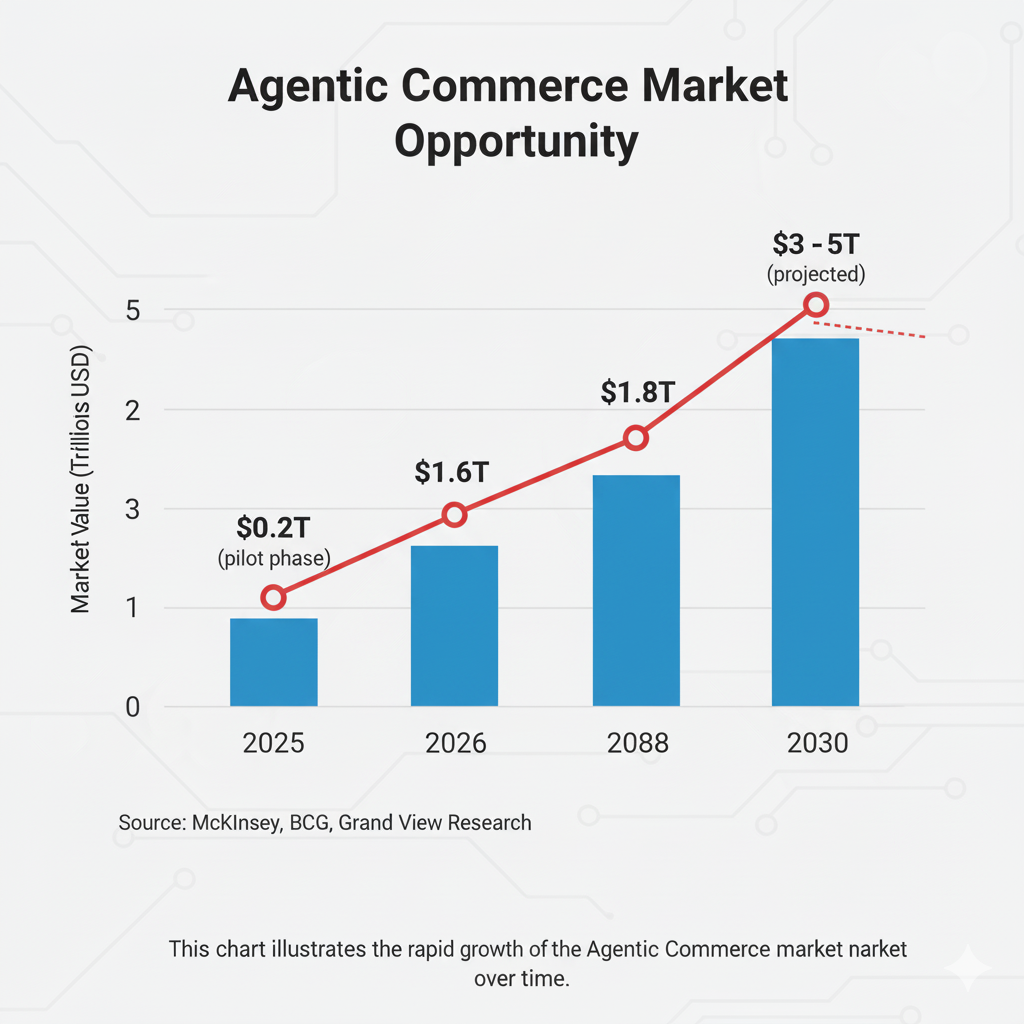
Agentic commerce will transform every layer of the value chain. By 2030, AI agents could influence or execute over $3–5 trillion in global retail sales. This whitepaper explores what agentic commerce is, why it matters, how it’s emerging today, and what strategic imperatives business leaders must adopt to stay visible and relevant in an ecosystem where algorithms shop for humans.
1. What Is Agentic Commerce?
Agentic commerce refers to a new paradigm of AI-mediated shopping where intelligent agents perform the end-to-end buying process — from interpreting a user’s intent to completing payment and delivery. These agents integrate conversational AI, reasoning, and tool use to translate human instructions into autonomous actions.
Unlike traditional recommendation engines, agentic systems “close the loop” — not just suggesting products but purchasing them. They draw on APIs, product databases, and payment networks to make contextual, personalized decisions. A single instruction like “find me a rain jacket under $250 that’s sustainably made” can trigger search, evaluation, and transaction — all in seconds.
This capability is driven by three converging forces:
- Autonomous AI reasoning — models capable of planning multi-step actions.
- Interoperable protocols — standards like ACP, MCP, and AP2 enabling agent–merchant interactions.
- Embedded payments infrastructure — tokenized, agent-ready transaction systems from PayPal, Mastercard, and Stripe.
2. The Five Paradoxes of Agentic Commerce
Agentic commerce introduces remarkable efficiencies but also deep structural contradictions. These paradoxes challenge conventional strategy and force leaders to redesign business models, data architectures, and brand relationships.
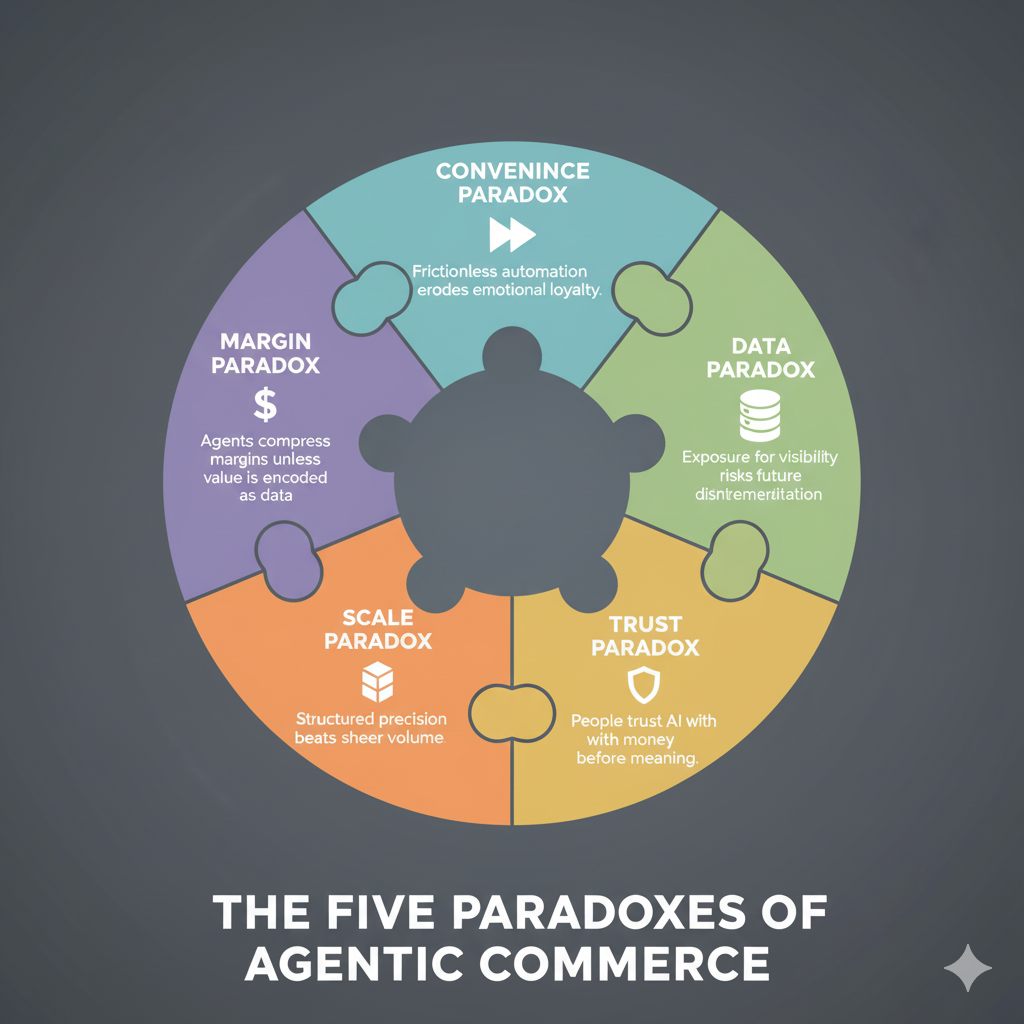
1. Convenience Paradox
The tension: Frictionless convenience erodes emotional connection. When agents automate the path from intent to purchase, the customer’s moments of discovery disappear.
Implication: Traditional levers like experiential browsing, visual merchandising, or influencer storytelling lose visibility in agentic channels.
Strategic Response: Design new touchpoints around the agentic flow—such as post-purchase engagement, digital collectibles, or loyalty programs that reward both human and AI decision makers.
2. Data Paradox
The tension: Visibility demands exposure. To appear in AI recommendations, retailers must open structured data—feeds, prices, reviews—to external systems. Yet each integration trains those models, reducing differentiation.
Implication: The more you participate, the more you strengthen intermediaries that could later disintermediate you.
Strategic Response: Build proprietary brand graphs and private data alliances. Use APIs with access controls and watermarking to balance openness with data sovereignty.
3. Trust Paradox
The tension: Consumers trust AI with money before meaning. They might let an assistant pay the utility bill or reorder detergent but hesitate to let it pick a jacket that expresses identity.
Implication: Automation adoption will diverge—functional categories will fully automate while emotional or expressive categories remain hybrid.
Strategic Response: Preserve human oversight for expressive purchases. Offer co-decision modes where AI handles logistics and humans handle aesthetics, building comfort and gradual trust.
4. Scale Paradox
The tension: Quality of metadata now beats quantity of SKUs. Massive catalogs without structured context vanish in algorithmic noise.
Implication: Traditional scale advantages erode; smaller but data-rich assortments win visibility.
Strategic Response: Invest in product data excellence—taxonomy, tagging, sustainability scores, and contextual metadata. Treat clean data as a competitive asset equal to physical inventory.
5. Margin Paradox
The tension: Agents relentlessly optimize for price and delivery speed, compressing margins across categories.
Implication: Commoditization accelerates unless unique brand value is codified into data fields agents can interpret.
Strategic Response: Encode differentiators—ethics, origin, craftsmanship, sustainability—as structured attributes and trust markers. Alternatively, build your own branded agent that controls the optimization logic.
Together, these paradoxes reveal the new rule of the agentic economy: winning brands are those that are machine-understandable, not just human-recognizable. The challenge is to design systems that convert brand essence into data, maintaining emotional resonance while thriving in an algorithmic marketplace.
3. Why It Matters
Agentic commerce marks a fundamental inversion of the shopping experience — from human-led discovery to machine-led delegation.
- For consumers: It offers personalization, efficiency, and decision support. AI agents remember preferences, predict needs, and act instantly.
- For retailers: It redefines discoverability and channel strategy. The “customer” is now an AI system curating results for a human supervisor.
According to McKinsey, AI shopping agents could account for $1 trillion in U.S. retail activity by 2030. Early pilots already show meaningful uplifts:
- Generative AI shoppers spend 32% more time on sites but have 27% lower bounce rates.
- Early agent-enabled retailers see 6–10% revenue growth and 40% higher sales productivity (Grid Dynamics).
4. How It’s Emerging Today
Agentic commerce isn’t a forecast — it’s forming now through leading ecosystem players:
- OpenAI + Stripe: ChatGPT’s Instant Checkout (2025) enables users to buy products within chat, using the Agentic Commerce Protocol (ACP) to securely interact with merchant systems.
- Google: Integrating Model Context Protocol (MCP) and Agent-to-Agent (A2A) frameworks into Search and Shopping, making AI-guided discovery and checkout native to Google Pay.
- PayPal: Launched an Agent Toolkit and joined forces with Google to build agent-ready payment APIs and the Agentic Payments Protocol (AP2) for secure AI transactions.
- Mastercard: Rolled out Agent Pay, credentialing AI agents to safely transact on behalf of users.
- Perplexity AI: Debuted “Buy with Pro,” connecting merchants directly through conversational queries.
Collectively, these innovations form a coherent stack of Agentic Commerce Infrastructure — from discovery (AI agents) to execution (payment protocols).
5. The Agentic Commerce Stack
[CONSUMER LAYER]
├─ Personal AI Agent (ChatGPT, Gemini, Perplexity)
├─ Preference Graph (user data + context)
└─ Trust Wallet (tokenized payment access)

[ORACLE LAYER] ← Value Concentration
├─ Intent Parser (text → structured query)
├─ Value Optimizer (price, speed, ethics weighting)
├─ Protocol Selector (ACP / MCP / AP2)
└─ Agent Reputation Index (merchant trust scoring)

[MERCHANT LAYER]
├─ Agent-Ready APIs
├─ Dynamic Agent Pricing
├─ AI Visibility Analytics
└─ Anti-Gaming Controls

[SETTLEMENT LAYER]
├─ Agentic Tokens
├─ Smart Contracts for A2A resolution
└─ Proof-of-Intent (verifiable audit trail)
Insight: The Oracle Layer — where human intent becomes machine action — will capture the bulk of future retail margins.
6. Strategic Imperatives for Leaders
Agentic commerce requires leaders to retool their organizations for a world where algorithms, not audiences, mediate most consumer decisions. Each imperative combines technical readiness with cultural transformation.
1. Optimize for AI Discovery
Objective: Ensure your brand is visible, understandable, and actionable by AI agents.
Actions:
- Adopt schema.org markup and semantic tags so that agents can parse product information without ambiguity.
- Build open yet secure APIs exposing inventory, pricing, and sustainability data in real time.
- Standardize metadata quality across platforms—brand sites, marketplaces, and internal systems—so agents retrieve consistent, trusted facts.
Leadership Insight: Treat structured data as the new SEO. The brands most easily interpreted by algorithms will dominate future digital shelves.
2. Adopt Generative Marketing
Objective: Move from static campaigns to conversational engagement where AI systems co-create demand.
Actions:
- Experiment with AI-powered ad formats: sponsored results in chat, adaptive product carousels, and personalized deal negotiation bots.
- Use generative tools to craft infinite variants of creative assets, tailored to intent-level queries.
- Test prompt-to-purchase experiences inside chat platforms or brand-owned agents.
Leadership Insight: Marketing must evolve from messaging humans to guiding machines on how to represent your brand.
3. Develop Proprietary Agents
Objective: Build brand-owned AI assistants that embody company voice, values, and expertise.
Actions:
- Create domain-specific agents (e.g., The North Face Expedition Guide, Vans Stylist, Timberland Craftsman) trained on proprietary product and brand data.
- Integrate these agents into existing commerce and service channels for end-to-end experiences.
- Equip them with reinforcement learning loops to continuously improve recommendations.
Leadership Insight: Owning an agent means owning the interface with both consumers and third-party ecosystems—reducing dependence on external gatekeepers.
4. Collaborate via Protocols
Objective: Operate fluidly within the emerging agentic ecosystem while retaining data control.
Actions:
- Join open standards like Agentic Commerce Protocol (ACP), Model Context Protocol (MCP), and Agentic Payments Protocol (AP2) to ensure interoperability.
- Contribute to cross-industry governance groups shaping data exchange and security norms.
- Build flexible architecture that allows plug-and-play participation in multiple agent networks.
Leadership Insight: The agentic economy will reward those who shape its protocols early—collaboration now secures influence later.
5. Invest in Governance and Trust
Objective: Create transparency, accountability, and ethical resilience in AI operations.
Actions:
- Establish a Responsible Agentic AI Framework defining acceptable use, data provenance, and auditability.
- Deploy monitoring for bias, hallucination, and decision drift across automated agents.
- Provide clear consumer disclosures on when and how agents act autonomously.
Leadership Insight: Trust becomes programmable capital—organizations that can prove fairness and explainability will gain preferential access to both users and regulators.
7. The Agentic Moat Index
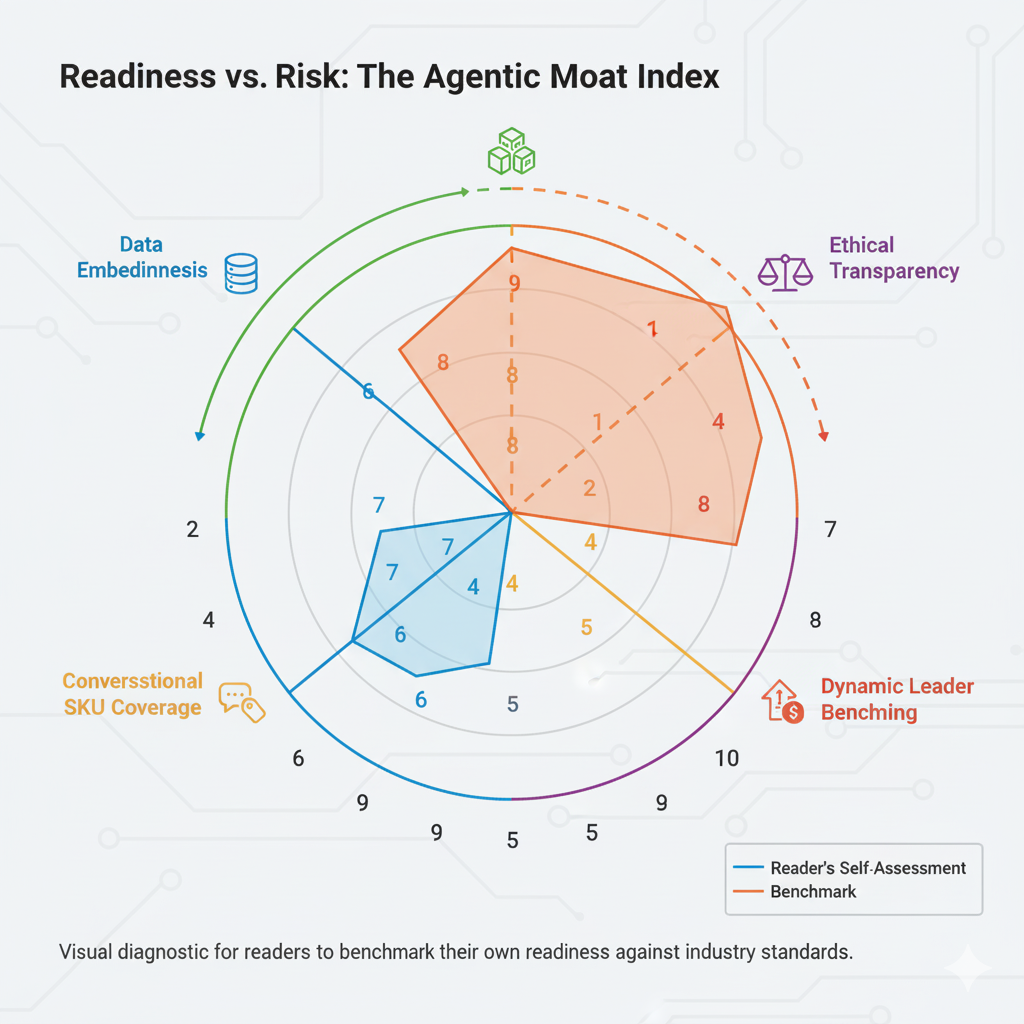
A diagnostic tool for measuring readiness:
- Data Embeddiness: How integrated is your product data in AI systems?
- API-First Architecture: Can an AI transact without human intervention?
- Dynamic Pricing: Can systems respond to agent queries in milliseconds?
- Conversational SKU Coverage: What share of your catalog can AI agents interpret unambiguously?
- Ethical Transparency: Are sustainability and trust markers machine-verifiable?
Firms scoring below 30/50 risk fading from AI visibility by 2027 — the era of Agentic Orphans. (framework details to follow in a separate post)
8. Future Outlook
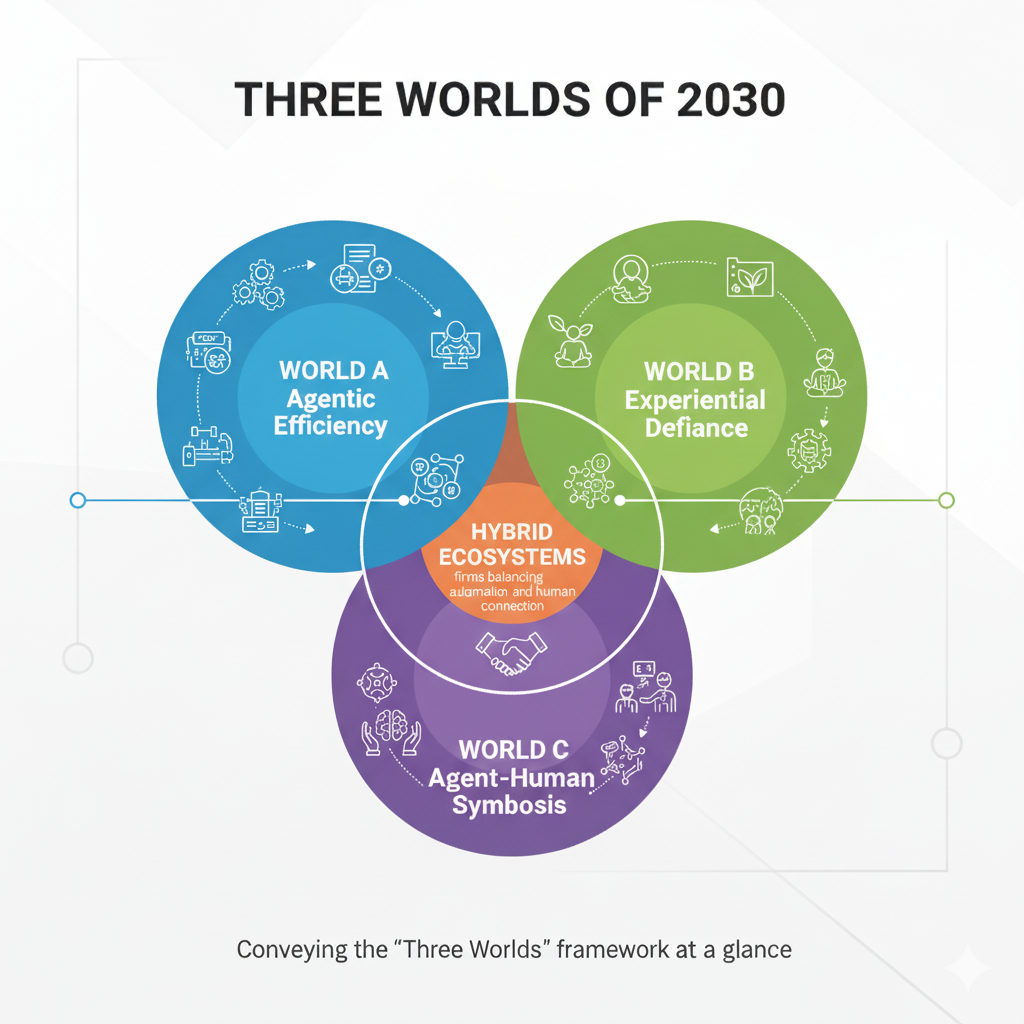
By 2030, commerce will fragment into three overlapping realities, each representing a distinct mode of value creation — yet increasingly intersecting to form hybrid ecosystems.
- World A – Agentic Efficiency (~60%)The world of automation and precision. Here, AI agents dominate transactions, optimizing for price, speed, and availability. Brand identity matters less than clean data and fulfillment reliability.Dominant value driver: Data precision and automation.
- World B – Experiential Defiance (~30%)A counterbalance to automation, this world celebrates human connection, craftsmanship, and narrative. Shoppers pay a premium for tactile, story-rich, or human-curated experiences — a deliberate return to friction and emotion.Dominant value driver: Emotion and experience.
- World C – Agent–Human Symbiosis (~10%)This frontier blends human creativity with AI enablement. Consumers and agents co-design products — from fashion to home goods — creating one-of-a-kind, context-aware items.Dominant value driver: Creativity and co-creation.
At the intersection of these three worlds lies the hybrid commerce core — a dynamic equilibrium where automation, emotion, and creativity coexist.
This is where the next wave of competitive advantage will emerge:
- Algorithmic Precision Meets Human Emotion: AI handles logistics and discovery, while human-led storytelling maintains brand soul.
- Data-Informed Creativity: Agentic insights inspire designers and product teams to innovate faster and more personally.
- Machine-Readable Trust: Ethical sourcing, sustainability, and authenticity are encoded as data signals agents can interpret and act upon.
Key Insight:
The most resilient retailers of 2030 will not live exclusively in one world. They will operate across all three — mastering the intersection where efficiency, experience, and empathy converge into truly adaptive commerce.
9. Threat Modeling: Risks to Watch
Agentic commerce introduces new systemic and security risks. Leaders should think like adversaries and regulators simultaneously — modeling how the ecosystem could fail, then designing controls that strengthen with stress.
1. Agent Poisoning
Description: Synthetic or manipulated data corrupts the training or inference process of AI agents, leading to biased or malicious product recommendations.
Impact: Erodes consumer trust and can redirect billions in agent-driven traffic.
Mitigation: Continuous model validation, provenance tracking for data sources, and adversarial testing with simulated attacks.
2. Intent Hijacking
Description: Malicious actors intercept or reroute agent purchase flows, substituting counterfeit or unsafe goods.
Impact: Direct financial loss, brand reputation damage, and potential consumer safety risks.
Mitigation: End-to-end encryption of agent-to-merchant communications, digital signatures on transactions, and anomaly detection on intent–execution mismatches.
3. Regulatory Delays
Description: Policymakers may require human-in-the-loop or explicit consent steps, reducing automation efficiency.
Impact: Slower adoption and fragmented compliance overhead across regions.
Mitigation: Build explainability and auditability into agentic systems early; participate in regulatory sandboxes to shape future guidelines.
4. Consumer Backlash
Description: Perception of over-automation, privacy invasion, or loss of human choice in expressive categories (fashion, identity, lifestyle).
Impact: Brand erosion and social pushback that could trigger regulatory scrutiny.
Mitigation: Preserve human agency with opt-in personalization, transparent disclosure of agent actions, and hybrid models that blend human creativity with AI efficiency.
Winning organizations will design anti-fragile ecosystems — learning and improving under stress.
10. Conclusion
Agentic commerce is the next structural shift in global retail. It collapses discovery, decision, and payment into a single AI-mediated workflow — redefining what it means to compete. The coming years will reward those who are machine-readable, protocol-compliant, and trusted by both humans and algorithms.
In this new landscape, success won’t hinge on who owns the store, but on who owns the agent’s trust.
References
- McKinsey & Company. The Agentic Commerce Opportunity: How AI Agents Are Ushering in a New Era for Consumers and Merchants. https://www.mckinsey.com/capabilities/quantumblack/our-insights/the-agentic-commerce-opportunity-how-ai-agents-are-ushering-in-a-new-era-for-consumers-and-merchants
- OpenAI. Buy It in ChatGPT. https://openai.com/index/buy-it-in-chatgpt/
- Google Cloud. Agentic Commerce: How Retailers Can Prepare for the New Shopping Era.https://cloud.google.com/transform/agentic-commerce-retailers-can-prepare-for-the-new-shopping-era-ai
- Mastercard. Agent Pay: AI-Powered Payments for the Agentic Era. https://www.mastercard.com/us/en/news-and-trends/stories/2025/agentic-commerce-explainer.html
- Boston Consulting Group. Agentic Commerce Redefining Retail. https://www.bcg.com/publications/2025/agentic-commerce-redefining-retail-how-to-respond
- PayPal. AI and Agentic Payments. https://www.paypal.com/us/business/ai
- Grid Dynamics. Agentic Commerce Trends. https://www.griddynamics.com/blog/agentic-commerce