Cognition Is Cheap. Wisdom Is Expensive.
How cognition became a commodity — and why intelligence and wisdom are now our most valuable assets
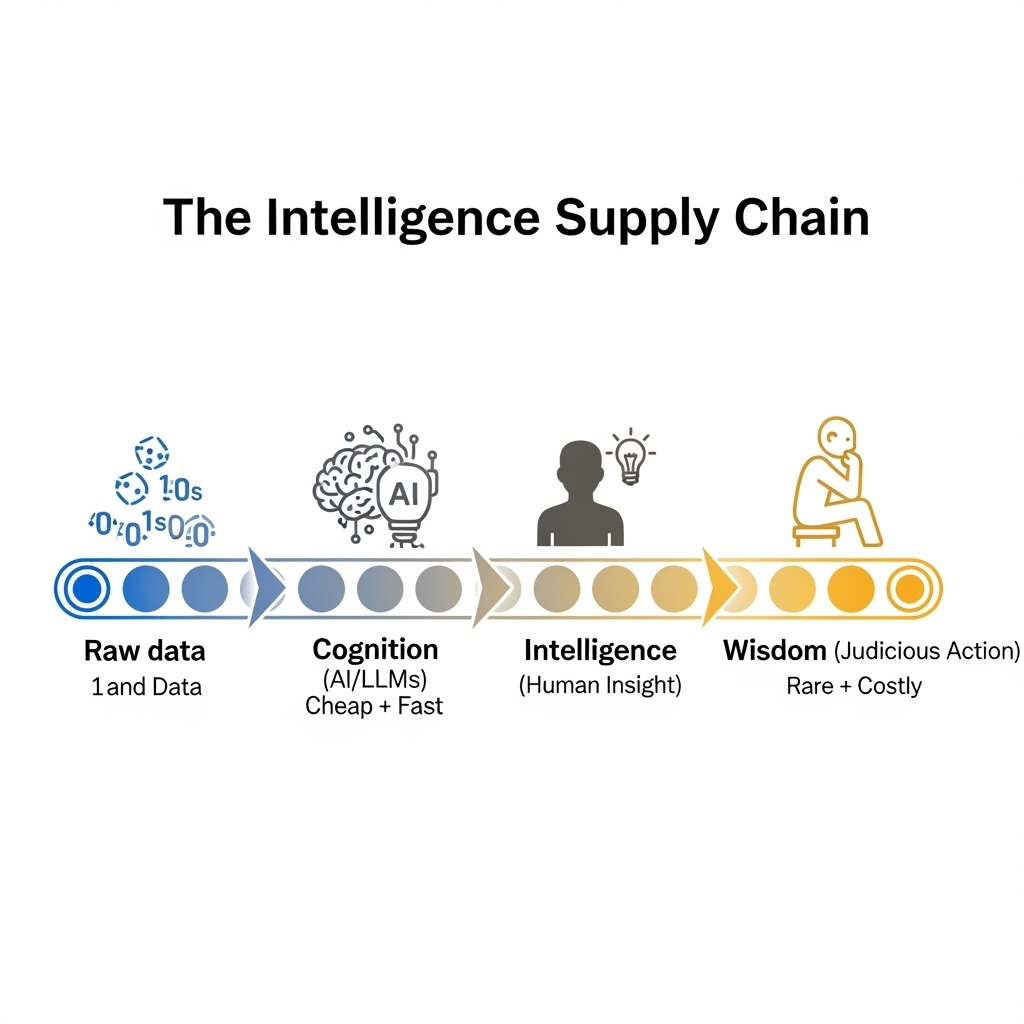
Before we begin, let’s define our terms:
- Cognition is the mental processing layer: learning, attention, memory, problem-solving. It’s the thinking engine.
- Intelligence is cognition applied — the ability to solve real-world problems, learn, adapt, and reason.
- Wisdom is the human OS — the capacity to make good decisions based on values, experience, and ethics.
For centuries, cognition was expensive. Today, it’s a line item — available via API for cents on the dollar. Intelligence is still hard. Wisdom? Scarce.
🧬 Evolution’s Biggest Spender
The adult human brain weighs 2% of your body mass but burns 20% of your resting energy. That’s ~12 watts, just to stay online. Evolution made a trade: more brains, less brawn. Around age 5, kids burn nearly half their total energy just to think — which explains the tantrums and slow growth.
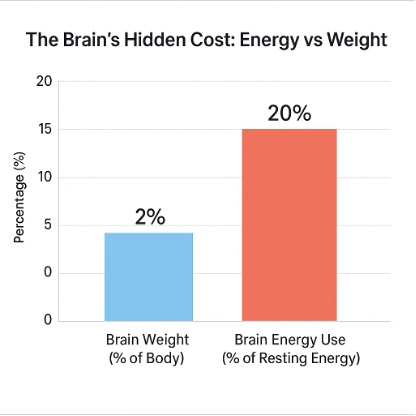
Brain weight as a percentage of body mass (~2%) and brain energy consumption as a percentage of total resting energy (~20%).
Intelligence was an evolutionary bet — one paid in calories, childhood, and complexity. The ROI? Language, tools, survival. But it wasn’t cheap.
🎓 Education: Intelligence as Capital
Once we realized smarts could be taught, we built cathedrals to it: schools, universities, think tanks. We spend $7.6 trillion a year globally on education. In the U.S., that’s $15K per student — 38% above the OECD average. Still, most developing countries can’t afford baseline literacy.
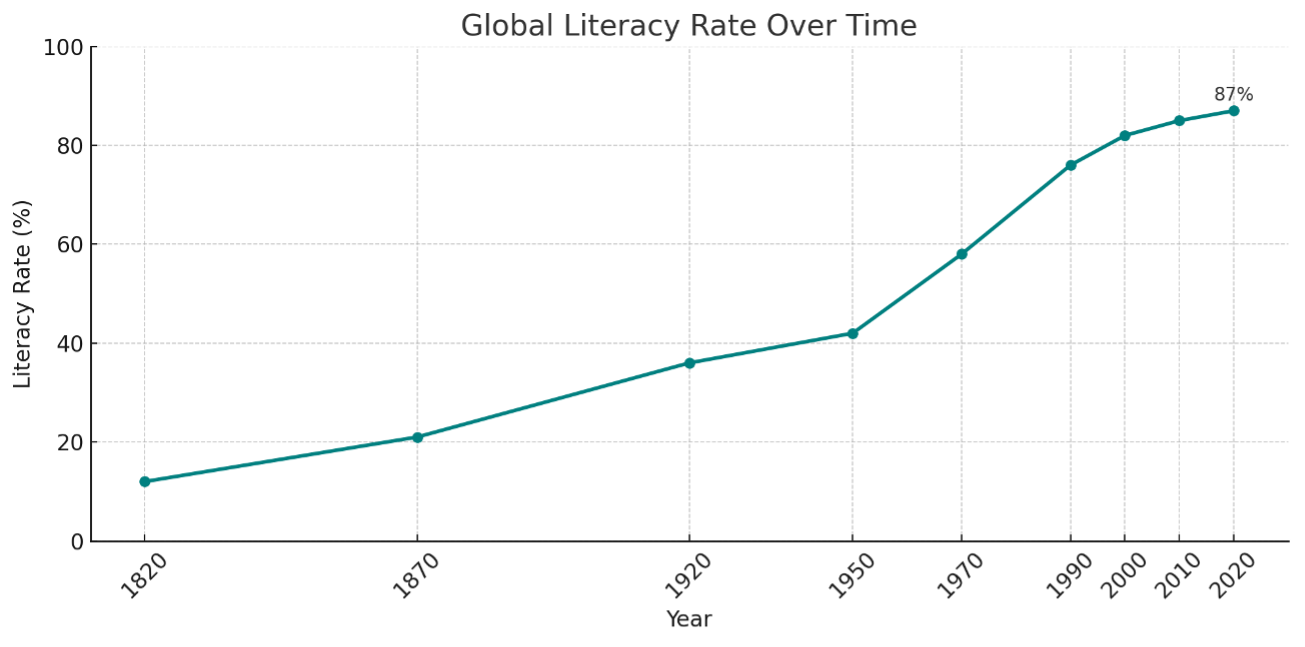
Global literacy rising from ~12% in the 1800s to nearly 87% today.
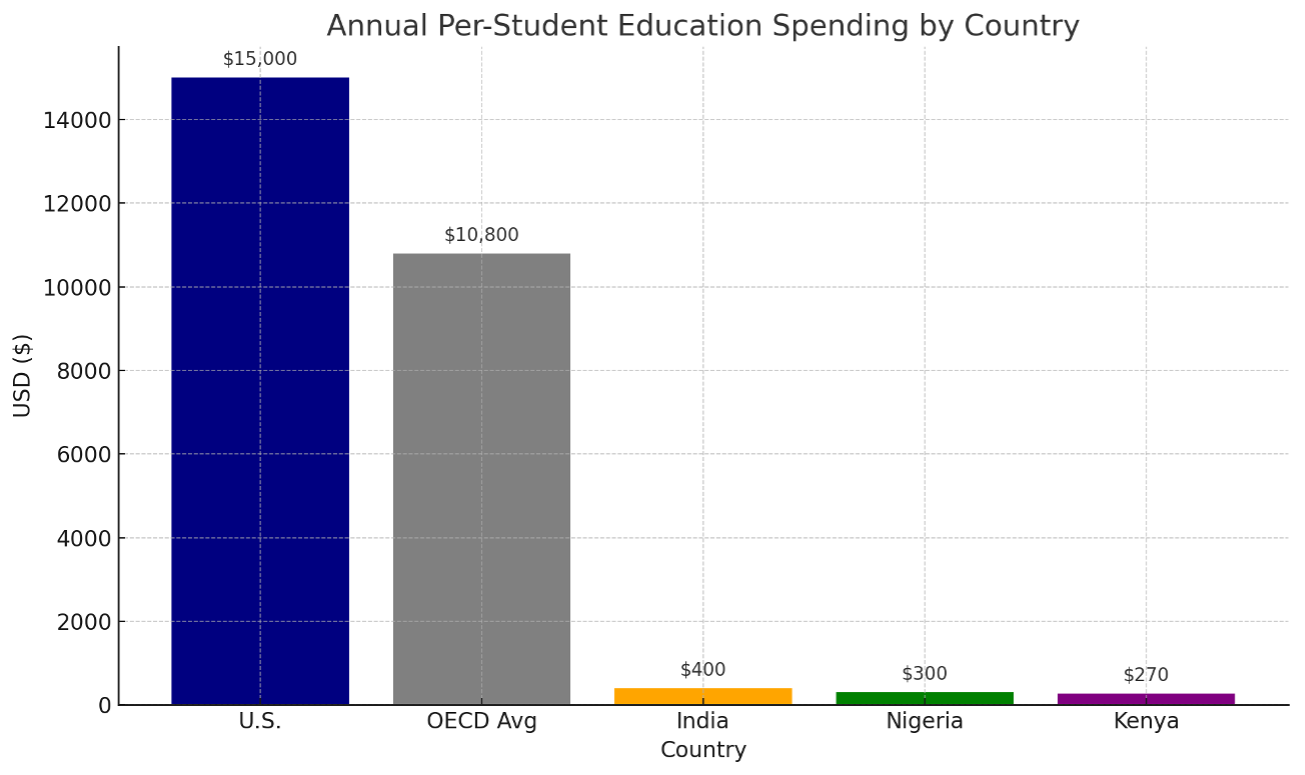
Per-student spending in the U.S., OECD average, and selected developing countries.
We’ve also enhanced intelligence with public health (goodbye lead paint, hello national IQ gains), tech (decision-support software), and nutrition. All in, we’ve built an economy on the back of brainpower.
🤖 Artificial Intelligence: The Premium Model
Then came AI — cognitive processing at industrial scale.
Training GPT-4 cost over $100 million. Running ChatGPT costs hundreds of thousands a day. AI compute grew 300,000x from 2012 to 2018. These aren’t platforms — they’re rocket engines made of GPUs, carbon, and capital.
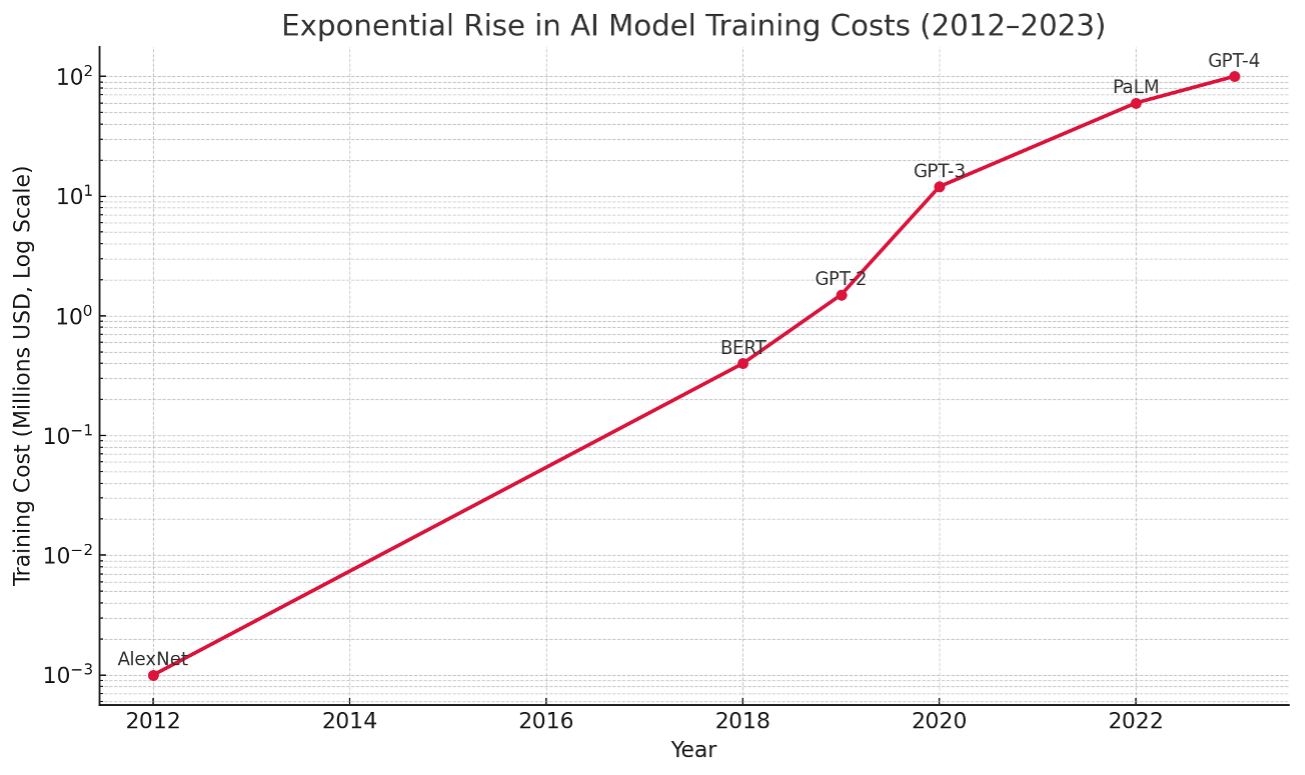
Exponential rise in AI model training costs from AlexNet (2012) to GPT-4 (2023).
Environmental impact? GPT-3 used ~1,287 MWh and emitted 500+ tons of CO₂. That’s five cars over a lifetime — or 550 New York–L.A. flights.
And yet... the bet is on. AI is projected to add $15 trillion to global GDP by 2030. It’s the new electricity. Expensive to build. Cheap to use.
📉 The Deflation of Cognition
As AI systems evolved from handling narrow tasks to demonstrating broader reasoning, we’ve reached escape velocity.
As AI progresses from performing isolated cognitive tasks to demonstrating more integrated forms of intelligence, the cost of both cognition and applied intelligence continues to fall — but wisdom remains untouched.
Training models is costly. Using them? Dirt cheap.
A few cents per API call unlocks answers that once required analysts, coders, or consultants. Tools like ChatGPT and Claude. Multi-agent systems (e.g., AutoGPT, CrewAI) that chain reasoning and tools. One input → complete strategy doc.
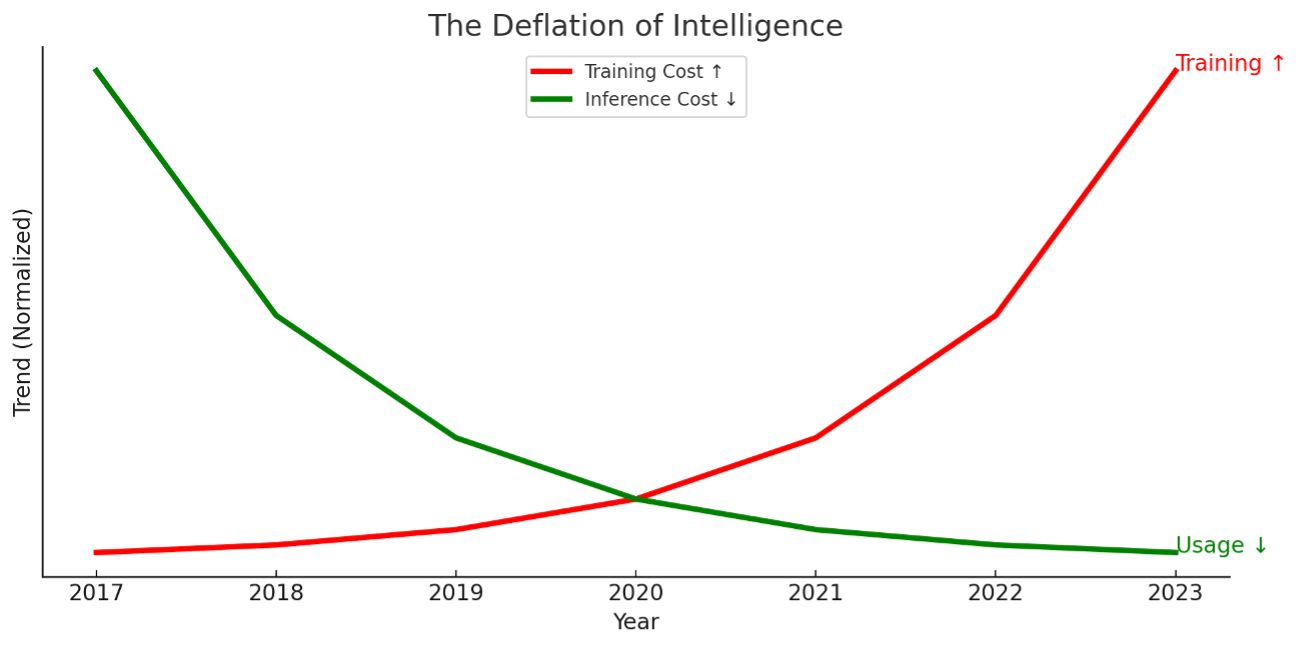
Training costs rising while usage costs plummet — a visual snapshot of the deflation of cognition.
Cognition is now offered like a utility — available on demand, through APIs or platforms. What began as simple output generation has evolved into systems capable of initiating and coordinating tasks autonomously. Thinking — outsourced.
⚙️ Agentic AI & Autonomous Action
We’re no longer just getting output on command. This is where cognition begins to evolve into applied intelligence — not just answering, but acting, learning, and coordinating.
Agentic AI refers to systems that act with purpose. These AIs don't just respond — they plan, make decisions, and use tools to pursue goals across multiple steps. Think interns who never sleep and don't need coffee breaks.
Now add hardware: autonomous robots, vision-enabled drones, warehouse bots. These are the legs and hands of AI. With cognition deflating, physical automation is now the bottleneck — and the next breakthrough.
What do you get when you plug cheap cognition into cheap robotics?
Infrastructure that thinks. Labor with no payroll. Systems that plan and build... other systems.
🧠 Bio-AI Convergence: Silicon + Synapse
Next stop: biology.
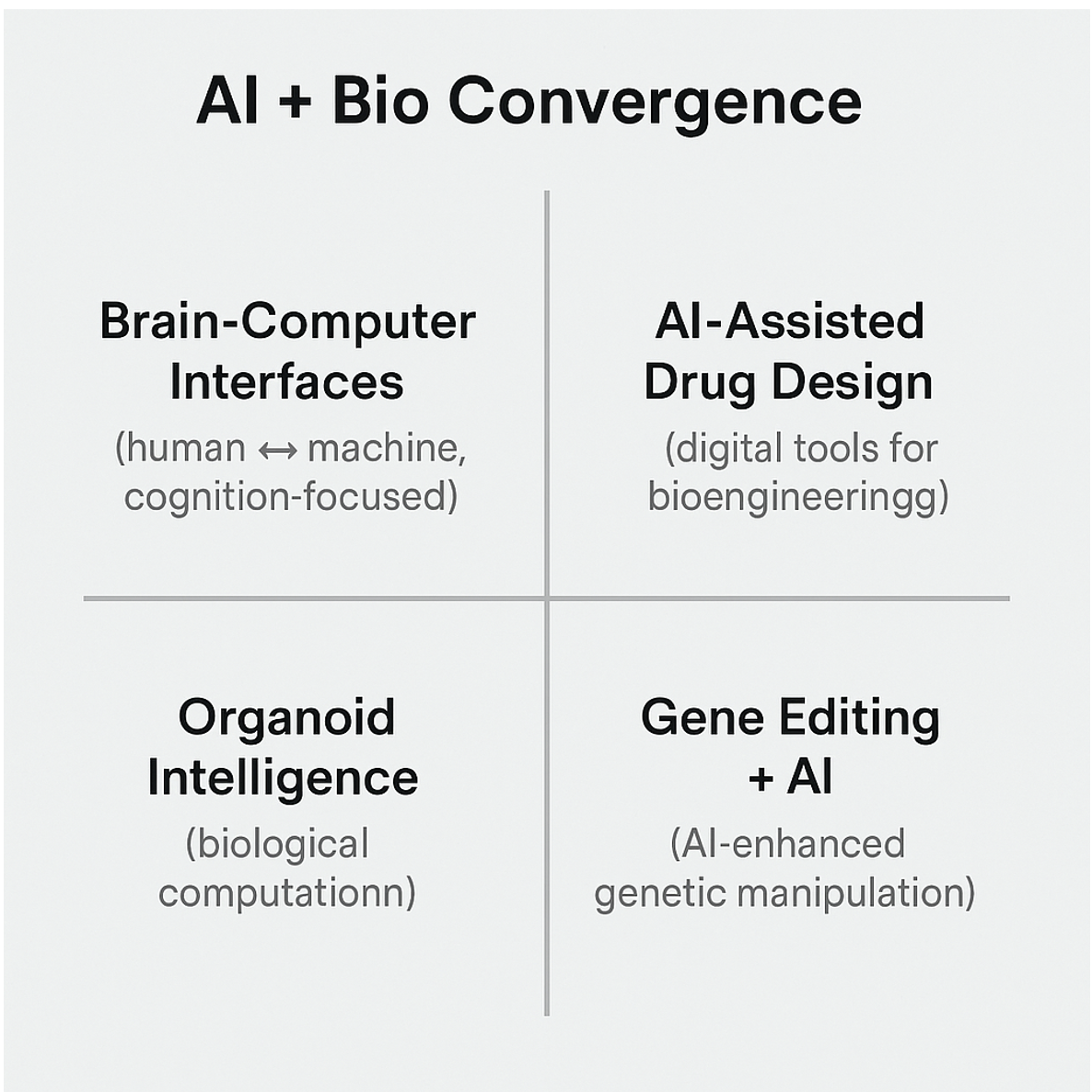
How AI intersects with biological systems — from brain-computer interfaces to organoid intelligence.
- AI-designed drugs: 46-day discovery cycles
- Brain-computer interfaces: Neuralink and its rivals aim to blur the mind-machine line
- Memory prosthetics (devices that help store and retrieve memories), neuro co-processors (AI chips working alongside our brains), “thinking assistants” (digital helpers for cognitive tasks) — once sci-fi, now prototypes
- Organoid intelligence: Lab-grown brain cells computing at low energy and high complexity
AI isn’t just externalizing cognition. It’s merging with the nervous system.
The future isn’t digital vs. biological.
It’s digital + biological — an intelligence stack from molecule to machine.
⚖️ Societal Trade-offs: Cognition is Cheap, Decisions Are Not
The cost of intelligence isn’t just economic—it’s moral, ecological, and geopolitical.
Privacy erodes as models scrape the internet for training data. Jobs shift rapidly—Goldman Sachs estimates 300 million jobs could be affected globally. Meanwhile, AI arms races fuel geopolitical tensions, and environmental concerns rise as compute-intensive AI scales up.
There’s a deeper tension at play: should the next dollar fund a neural network or a neighborhood school? The market currently favors AI, but societies must ensure biological intelligence isn’t left behind. Skipping investment in public education while spending billions on AI is like upgrading your software while letting your hardware fall apart.
🧭 What We’re Funding vs. What We’re Missing
To sharpen the picture, let’s visualize where we’re spending — and where we should be.

We’re overfunding areas with explosive geopolitical and economic consequences while underfunding those with quiet, long-term returns — like education and trust infrastructure. The best ROI may come from cheap, underfunded sectors. But markets don’t always reward what’s optimal. They reward what’s monetizable.
📚 Final Thought: Cognition vs. Intelligence vs. Wisdom
Cognition is cheap — prompt in, output out. Intelligence is harder — knowing what to do with that output. Wisdom is rare — knowing when not to act.
AI won’t replace people. But people who wield cognition with discernment — who ask better questions and act with judgment — will outpace those who don’t.
We can rent intelligence by the minute. But judgment remains handcrafted, slow-grown, and irreplaceable.
In this age of ambient thinking tools and limitless answers, the real edge is not knowing more — it’s knowing what matters.
Let others optimize for output. You? Optimize for insight.
Because in a world where cognition is cheap, wisdom becomes your most valuable asset.
Sources: Stanford HAI, HolonIQ, Fortune, Our World in Data, Cudo Compute, PNAS, WEF, OpenAI, Gartner, PwC
.