
The New Frontier of Digital Discovery: Why Generative Engine Optimization (GEO) Is Crucial for eCommerce
A Playbook for Large Brands to Succeed in the Age of AI-Powered Search
Introduction: The Rise of AI-Powered Search
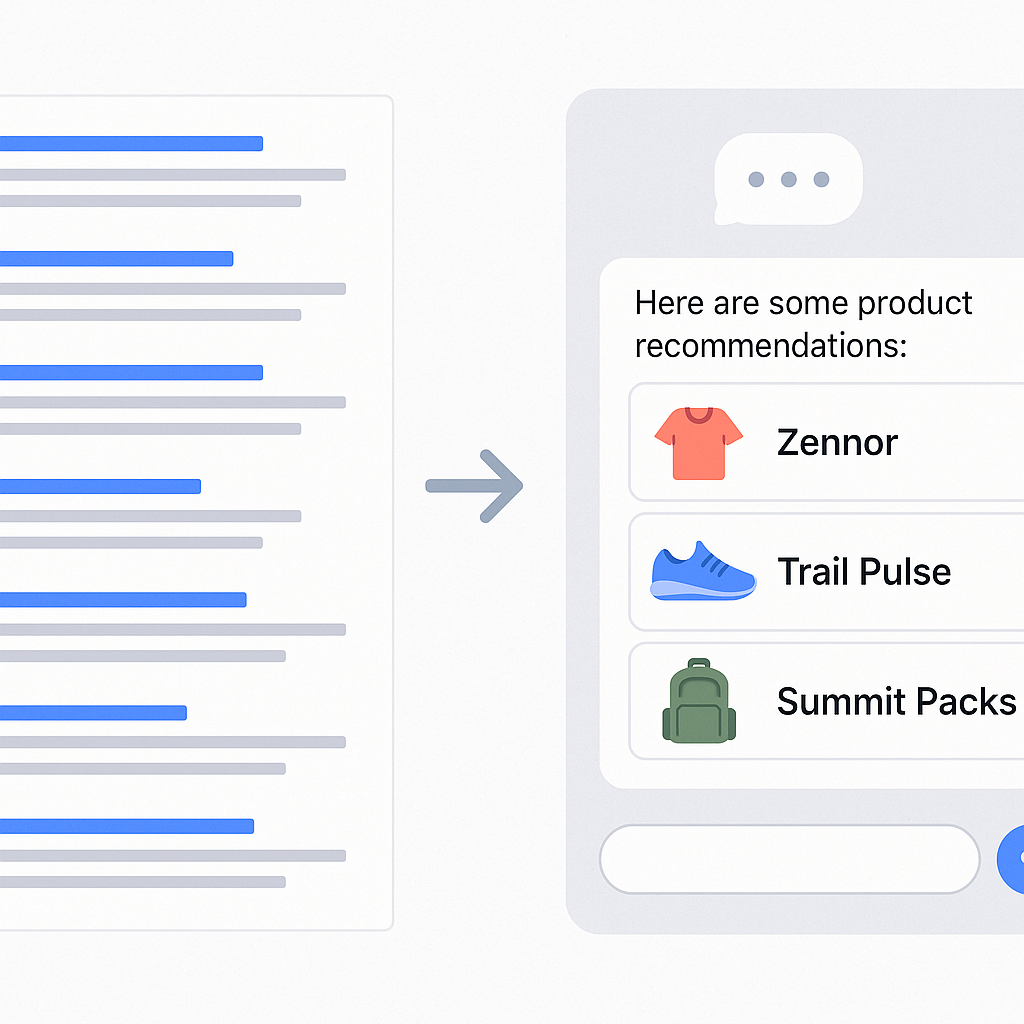
Imagine asking, "What’s the best laptop for college students?" and getting a concise, conversational answer from an AI like ChatGPT or Google Gemini, complete with product recommendations and reasons why. This is the new reality of search. Generative Engine Optimization (GEO) is the art and science of ensuring your brand’s content is not just found but trusted and cited by AI tools when they answer user questions. Unlike traditional search engine optimization (SEO), which battles for top spots on Google’s results page, GEO focuses on making your content the backbone of AI-generated responses. As consumers increasingly turn to AI chatbots for quick, reliable answers, GEO is becoming the key to staying visible in this evolving digital landscape.
Why AI Search Matters for Your Brand
The way people search is changing fast. Instead of typing keywords into Google and sifting through links, more users are asking AI tools like ChatGPT, Perplexity, or Google Gemini for direct answers to questions like, "What’s a good 4K TV under $1000?" or "Which running shoes help with flat feet?" These AI systems don’t serve up a list of websites—they deliver a synthesized response, often pulling from multiple sources to create a single, authoritative answer. If your brand or product isn’t part of that response, you’re effectively invisible to these users.
Recent data paints a clear picture: 58% of consumers already prefer AI tools over traditional search engines for certain queries, and 64% trust AI recommendations enough to make a purchase based on them. Analysts at Gartner predict that by 2026, traditional search engine use could drop by 25% as AI-powered tools take over. For eCommerce brands, this shift is a wake-up call. Your digital strategy can no longer rely solely on ranking high on Google. You need to design content that AI systems can easily understand, trust, and cite. Without GEO, you risk being left out of the conversation entirely, especially as competitors start adapting to this new reality.
Consider a small eCommerce brand selling eco-friendly water bottles. In a traditional search, their product page might rank on page two of Google—still reachable with effort. But in an AI-driven search, if their content isn’t structured to answer questions like, “What’s the best reusable water bottle for hiking?” they won’t even be mentioned. GEO bridges this gap by making your content AI-ready, ensuring it’s part of the answers users receive.
GEO vs. SEO: A New Approach to Visibility
Traditional SEO is all about climbing the ranks of search engine results pages (SERPs). It’s a game of optimizing keywords, crafting compelling meta descriptions, building backlinks, and ensuring your website loads quickly. GEO, however, plays by different rules. Its goal is to make your content the go-to source for AI systems when they generate answers. While SEO targets human searchers scanning a list of links, GEO caters to AI engines that summarize information conversationally. Here's how they differ:
Objective:
SEO: Rank in search engine results.
GEO: Be cited directly in AI-generated answers.
Focus:
SEO: Keywords, meta tags, and backlinks.
GEO: Contextual clarity, E-E-A-T, and Q&A formatting.
Metrics:
SEO: Search rankings, click-through rates, and bounce rates.
GEO: Mentions in AI-generated summaries, referral traffic from AI tools, and brand citation volume.
Audience:
SEO: Humans interpreting search engine results pages (SERPs).
GEO: AI engines summarizing and responding to user queries conversationally.
Real-World Example: The Nike Miss
A user asked ChatGPT: "What are the best running shoes for flat feet?" Despite Nike’s prominence, the AI didn’t mention a single Nike shoe. Why? Nike’s product pages and content lacked the depth and specificity other brands provided—missing an opportunity to answer that question authoritatively.
If you’re not visible in AI-generated answers, you’re not even in the consideration set.
How to Win at GEO (Especially for ChatGPT)
- Enable AI Crawling: Ensure your site isn’t blocking OpenAI or Bing bots. Update robots.txt to allow crawling.
- Use Q&A Formats: Create FAQs and Q&A-style content that mirrors how users ask questions.
- Implement Schema: Add structured data (FAQPage, Product, HowTo) to help AI identify key elements.
- Demonstrate E-E-A-T (Experience, Expertise, Authoritativeness, and Trustworthiness): Include expert quotes, original research, and trust signals (certifications, awards, reviews).
- Write Conversationally: Use natural language that’s easy to summarize.
- Update Frequently: AI prefers recent, relevant, and factual content.
- Optimize Product Pages: Add use-case-driven content like “Great for marathon training” or “Ideal for beginners.”
- Expand Your Digital Footprint: Publish on LinkedIn, Medium, YouTube (with transcripts), and credible third-party blogs.
The 5-Step GEO Playbook
Use this playbook to operationalize your GEO strategy:
- Identify: List your top-converting or high-margin products and pair them with common customer queries using AI tools or keyword research.
- Optimize: Rewrite and structure content to match conversational intent, include Q&A format, and add schema markup.
- Test: Prompt ChatGPT, Perplexity, and Gemini with sample queries—track if your brand is mentioned or linked.
- Track: Monitor traffic, brand mentions, and AI citations over time. Create a GEO dashboard for stakeholders.
- Iterate: Use feedback loops to update stale content, fix missing schemas, and close gaps with competitor coverage.
Starter Toolkit: Getting Started with GEO
- 🧰 Schema Generator: https://technicalseo.com/tools/schema-markup-generator/
- 🧪 Rich Result Testing Tool: https://search.google.com/test/rich-results
- 🔍 Prompt Testing: Use ChatGPT and Perplexity to test how your brand surfaces for various queries.
- 📊 Monitoring Tools: Google Search Console (SGE impressions), Bing Webmaster, Google Analytics (AI referral segments)
- 📓 Citation Tracker Template: Create a shared sheet to log where, when, and how your brand appears in AI-generated answers.
AI Query Examples to Guide Your Content
Here are the types of natural-language queries AI tools are processing daily. Your content should be structured to answer them directly:
- "What’s the best everyday laptop under $700?"
- "Which moisturizer works for dry skin in winter?"
- "Best noise-canceling headphones for remote work?"
- "Which shoes are best for marathon training with flat feet?"
Use these as inspiration to mirror similar phrasing in blog titles, FAQ sections, and product page headings.
Smart Repurposing: Extend GEO Across Channels
To amplify reach and reinforce your brand across platforms AI models ingest, consider these tactics:
- ✍️ Turn top-performing FAQs into LinkedIn carousels or slideshows.
- 🎥 Convert product Q&A content into short YouTube videos with transcripts.
- 🧵 Break down your long-form GEO checklist into a Twitter/X thread.
- 🎙️ Join industry podcasts or webinars and ensure they're indexed or transcribed for AI visibility.
- ✍️ Publish thought leadership or explainer pieces on Medium to build topical authority.
Tailoring for Different AI Engines
- ChatGPT: Prioritize clarity, structure, and schema markup. FAQs and how-tos work well.
- Perplexity: This one cites sources. Keep your content factual, up-to-date, and easy to quote.
- Gemini (Google): Stick to Google SEO principles but add conversational structure. Aim to be cited in SGE (Search Generative Experience) summaries. Pay particular attention to mobile-first indexing, page speed, and content freshness—factors Google has long prioritized and which likely inform Gemini’s generative selections as well.
- ChatGPT: Prioritize clarity, structure, and schema markup. FAQs and how-tos work well.
- Perplexity: This one cites sources. Keep your content factual, up-to-date, and easy to quote.
- Gemini (Google): Stick to Google SEO principles but add conversational structure. Aim to be cited in SGE (Search Generative Experience) summaries.
GEO Checklist for Your Team
This checklist is designed for SEO leads, content strategists, product marketers, and digital teams looking to align their content with AI search engines like ChatGPT, Gemini, and Perplexity. Use it to guide your end-to-end GEO initiative across on-page content, technical SEO, and external reputation management:
- Enable AI Crawling: Check robots.txt to ensure it allows OpenAI's
OAI-SearchBotand Bingbot. Confirm crawlability using tools like Bing Webmaster Tools. - Implement Schema Markup: Use structured data (FAQPage, Product, HowTo) to surface key content. Tools like Merkle’s schema generator or Google's Rich Results Test can help.
- Create FAQ and Q&A Blocks: Add conversational FAQs to product pages and blogs. Answer real user questions sourced from Google’s 'People Also Ask', Reddit, or Perplexity queries.
- Refresh Product Pages: Make your descriptions intent-rich. For example, add lines like "Great for flat-footed runners training for marathons." Include technical specs and lifestyle benefits.
- Monitor AI Mentions: Regularly test how ChatGPT, Bing, Perplexity, and Gemini respond to queries in your niche. Log whether your brand or content is cited.
- Update Legacy Content: Audit old blogs and guides for freshness, accuracy, and clarity. Replace outdated stats, add FAQs, and make language more natural.
- Optimize for Conversational Queries: Identify long-tail questions your customers ask. Use tools like Answer the Public, AlsoAsked, or ChatGPT prompt testing. Mirror these queries in your headlines and subheads.
- Distribute Across Platforms: Syndicate authoritative content to Medium, LinkedIn, Reddit AMAs, YouTube with captions, and other AI-indexable platforms.
- Track GEO KPIs: Monitor referral traffic from chat.openai.com, Bing Chat, and Perplexity. Use UTM links, branded search trend tracking, and time-on-page analytics.
- Build Off-Site Authority: Increase your chances of citation by getting referenced on high-authority blogs, podcasts, and community discussions in your industry.
- Document & Share Internally: Make GEO a standing agenda item across marketing and content teams. Share wins and losses from AI tests in weekly content reviews.
Measurement: New KPIs for a New Era
To evaluate the success of your GEO efforts, move beyond traditional SEO metrics:
- AI Citations: Run recurring prompts across ChatGPT, Perplexity, and Gemini to see if your brand or pages are referenced. Log them monthly.
- Referral Traffic from AI: Segment traffic from chat.openai.com, Bing Chat, or Perplexity using UTM codes and GA4 custom reports.
- Brand Search Lift: Monitor branded queries in Google Search Console over time. Increases may signal AI-driven brand discovery.
- Engagement Rates from AI-Sourced Visitors: Track bounce rates, time on page, and scroll depth segmented by referral.
- Conversion Rates from AI Recommendations: Create goal tracking funnels in GA4 for visitors arriving via AI engine sources. Use that to calculate ROI on GEO-focused content. (Are you mentioned by name?)
- Referral Traffic from AI (e.g., Bing Chat, Perplexity)
- Brand Search Lift (post-AI visibility)
- Engagement Rates from AI-Sourced Visitors
- Conversion Rates from AI Recommendations
Conclusion: Don’t Miss the AI Revolution
AI-powered search is transforming how consumers discover products, and GEO is your ticket to staying relevant. By making your content clear, trustworthy, and easy for AI to cite, you can ensure your brand is part of the answers users receive. The brands that embrace GEO now will lead in the AI age, while those that wait risk fading into obscurity. Start optimizing today to secure your place in the conversation.